Showing posts with label fitness. Show all posts

Thursday, 6 June 2024

Prime of My Life?


Ok, let's get this out of the way:

Yes, it's been a long time since I updated this site.

Yes, I have changed jobs/houses/cities/countries again, and yes, my children are now all bigger than me, which isn't fair. It's been a lot (especially the last bit).

But, let's talk about something else.

Doctor, Doctor!

While the kids had checkups and shots several months ago—because otherwise they couldn't go to school and I would have to teach them myself (no thank you)—I had my own first US medical experience yesterday, because, yikes, expensive. 

(We still sort of have Canadian healthcare, but it's a long, complicated process for partial reimbursement. We are very excited that we may, one day, get back a portion of the cost of the kids' state-required health assessments and immunizations, which, when it comes in, will literally pay for a weekend in New York).

For me, I'd found it impossible to find a doctor for myself, giving up after about four months of frustration. 

But then Fis had a concern, and couldn't find a doctor in two days. So, he asked his colleagues what they did. (See, four months, above.) 

So, here's what he found out: somehow, "Amazon Doctors" are a thing (what is HAPPENING???). I signed up for this via my Prime membership (WHAT) two days ago... and had an appointment with my lovely new primary care practitioner yesterday morning. I left with referrals for a whole slew (not just half a slew, as you might expect) of other doctors, including  a dermatologist and a radiologist, and bloodwork (hello, cholesterol) too. 

I think my warranty has expired. 

Jumpstart my parts

Point: my left shoulder, last year, hurt so badly all the time that I could no longer do pushups.* (Gasp! I know!) Luckily, I'd had it treated and healed right before we moved here, thank goodness, by my mad chiropractor, who used: Active Release Therapy; Shockwave; ultrasound; cupping; acupuncture; and the special acupuncture that also involves electrocution. (Plus physio exercises.) He traumatised me deeply for four months straight, and voila! It's as good as new (though I will never be the same). 

He had fixed my other shoulder the year before, and both times, was like, "HOW did you even do this?" No idea, sir. Sure, stick that vibrating needle into me while I sweat. Please.

Heal thymyself?

But maybe I didn't need to put myself through all that. 

In March, I fell off a (ridiculously small) ladder while hanging didgeridoos, and sprained my right ankle horribly. I was in agony for days, walked with a cane, and could barely move or use the stairs for two full weeks. Even two months later, it was still swollen, and didn't feel right. I resigned myself to the possibility that I would probably never again turn a gentleman's head with my delicate instep run without pain.

BUT THEN! After ten full weeks of painful hobbling, I hopped over a curb, landing badly, twisting and going over my ankle—respraining my hurty ankle, which somehow fixed it completely (yay, science?). I went for a run the next day, realizing five minutes in that, perhaps, I shouldn't have mourned not being able to run, because it's awful.

AND I've realigned my left wrist. I noticed, while sitting with my swollen foot up on an ottoman, that I had a wonky bone sticking out (see also, warranty), and that it hurt (again) when I did pushups.* Here's how I fixed it: by actively not putting it into very weird positions for no good reason. Seriously. I'd find it tucked up/folded in half like a little wing while I watched tv or slept. By focusing on keeping my hand "normal", it got better, in only about six weeks. 

You should definitely follow me for health advice.

It wasn't supposed to happen to me

Like a sucker, I really believed that my entire lifetime of frequent exercise with cardiovascular and weight-bearing activities, coupled with a a pretty healthy diet and obsessive sunscreen use would have given me a leg up on this 'aging with dignity' thing. Alas, no. It's all lies. 

Tonight is pizza night, and I'm going to have it with wine and chips and probably some gin, and no sunscreen because the system is evidently broken.

But yes, my ankle is tantalizingly dainty again, thank you for asking.


*No, Mom, the answer is not, "Maybe you shouldn't be doing pushups."


Friday, 4 September 2020

Sending the Kids Back to an Active Lifestyle is More Important than Sending Them Back to School

A girl reclines on a couch with a book
Photo by Josh Applegate on Unsplash

Get them moving. Now. 

Lockdown, isolation, social distancing...whatever you practiced between March and September, I'm willing to bet your kids aren't as fit as they were.

From a global perspective, “prolonged home stay may lead to increased sedentary behaviours, such as spending excessive amounts of time sitting, reclining, or lying down.” Of course it did. 

We got far less auxiliary exercise (the steps I didn't take to bring the dog to the dog park, or even meet the kids at the bus stop across the street; the stairs you didn't climb up onto the top deck of the bus, the steps you didn't take to transfer tube lines or grab a coffee from the shop at lunchtime). All of these added up during a normal, pre-lockdown day. And there we were without them, for almost six months.

Now, what about the kids? Kids move a lot, far more than the average adult. They're supposed to.

Let me be clear: I’m not advocating for shaming kids for their perfectly-understandable, lowered fitness levels, or for pushing kids so hard that they get injured; I understand that they can’t just jump back into the pre-pandemic levels of activity, especially those that didn’t have a (cruel yet creative) mom. Most parents, while juggling working from home and home schooling, didn’t have the luxury (or patience, knowhow and inherent evilness, all important attributes for personal trainers) to coach their kids to move and stretch so much.

Read the whole article at Medium.com:

Is "Easing Back In" the Best Way to Go?

My kids have had more screen time since March than they have ever had in their lives. Cumulatively. Like, the time they have spent on screens between March and last week outweighs allll of the screentime they have ever had in their 7, 10 and 11 years, respectively.

Oh, and read this one, too.

"I Don't Need Anyone Pressuring Me to Work Out Right Now"

Remember when that photo of Adele went viral? A beautiful, incredibly-talented, successful woman and mother lost a lot of weight, and it broke the internet. People that have praised her new look have been vilified, because they must be celebrating looks and the diet culture over talent, are completely invalidating the rest of her accomplishments, and "skinny doesn't necessarily mean healthy".


Monday, 1 June 2020

Get Up and Dance

A girl swings her long red hair, smiling
Photo by Johnny McClung on Unsplash


A few months ago, when isolation regulations were still feeling new, a friend sent me a funny dance tutorial by Joe Tracini, and said, “Try this.”

I was having a terrible day. I felt sad, hopeless, depressed. After all, I was trapped inside my flat with my three children, dog and husband for the foreseeable future. I was cut off from my friends, my running group (not mutually exclusive) and the active half of my income-generating work: my bootcamps and fitness classes. 

I still am. And I still feel pretty terrible. But, I digress.

I watched the video, smiled sadly, and wrote back, "Sorry, I just can't right now."

Everyone knows how strongly I feel about exercise and living a very active life. My mother has borne the brunt of this since I was in high school, but hey, science backs me up on every front. We should all -- ALL -- be exercising regularly.  Even little bursts of movement make you healthier in so many ways. It also makes you feel better. 

I know this.

I tell the kids this all the time. Movement, but especially dance, lifts the spirits. Go ahead: just try to do the running man for 30 seconds with a straight face. Or the Charleston. Or the Floss.* I dare you to dance and stay in a bad mood. You just can't.

So, I put on a Beachbody workout, sluggishly went through the motions for a few minutes. I didn't work out because I wanted to, but because a) I knew it would make me feel better, less angry, less sad, and b) I was on a workout program, and I'm nothing if not a rule-follower. Within ten minutes, I was feeling slightly more cheerful. I jumped and lifted and sweated, and I felt better after. Better enough to take on the dance challenge.


Nailed it.

So, hey you -- yes, you -- get up and move. Dance and be silly. Do some jumping jacks, followed by squats and your choice of pushup variations. You'll feel better for it, I promise.

More on the science:

"I Don't Need Anyone Pressuring Me to Work Out Right Now"

Remember when that photo of Adele went viral? A beautiful, incredibly-talented, successful woman and mother lost a lot of weight, and it broke the internet. People that have praised her new look have been vilified, because they must be celebrating looks and the diet culture over talent, are completely invalidating the rest of her accomplishments, and "skinny doesn't necessarily mean healthy".


*See how many generations I've got covered there? 

Thursday, 2 April 2020

Fitness for Shut-ins Part Three: Fitness Tools and Trackers

If it's not tracked, did it even happen?


This is part three of a three-part series about staying fit and healthy while on lockdown. Read Part One and Part Two here.


A pair of running shoes sits beside a poseable wooden figurine in a dramatic pose on a windowsill.
Don’t worry. You’ll be out there again one day. (Image: author’s own.)
You’re stuck inside alone, or possibly with pets and other people that you used to like.

You need some kind of stress release, both as a way to combat the extra snacks you’re eating All. The. Time. and to stop you from killing the people that are Always. Right. There.

Yeah. You’re motivated to work out.

You’ve also sorted out where you’re going to work out, set up your schedule, and have access to countless options for indoor, small-space workouts.

All that’s missing is a way to ensure that you’re properly harnessing the essential element of improving your fitness level: progressive resistance and a way to keep yourself honest.

There are many easy ways to track your workouts, as well as many ways to share them for social support and bragging rights. I’ll outline several of my favourites here…and the below are all either free or have free versions available.

Tools and trackers for the self-motivated

Pencil and paper

Of course, you can just write it down. An actual, honest-to-goodness paper notebook or calendar is a great way to track your workouts (as is a chisel and slab of stone, for that matter). You can see at a glance what you did and when you did it, and it’s low-tech…never a need to upgrade or install updates.

Read more...


Monday, 30 March 2020

Fitness for Shut-ins Part Two: Workouts You Can Do in a Small Space

You already have the will. Here's the way.


You can get a great workout in a 2'x6' space. Please move your dog first. (Image: author's own)

Whether you're just at the physical distancing stage of this pandemic or you're in full lockdown, one thing is certain: you're not getting to the gym today. Depending on where you are and what you have access, to, there are some great free (or cheap) ways to stay fit while avoiding the rest of the world and/or being stuck at home.

How much space do you have?

A large backyard and an open-plan basement? A balcony the size of a yoga mat? An actual yoga mat beside your bed where you hide from your kids that are "homeschooling" themselves? There are lots of ways to get an effective workout even in a tiny space.

Yoga, calisthenics and Pilates are natural choices for small spaces. These two home workouts don't require any equipment, but will get your heart rate up in a 2' x 6' space:

KISS Your Excuses Goodbye
This small-space body-weight workout can be dialled up with cardio intervals or kept simple with supersets.

5 Exercises in 5 Minutes
Take five minutes to rev up your metabolism and wake up your body and mind.

Read more...

Wednesday, 25 March 2020

Fitness for Shut-ins Part One: Motivation vs Dedication

A three-part series about staying fit and healthy while on lockdown


These puppies are going to stay looking new for a while. (Image: author's own)


In this strange new world, it's going to be harder than usual to stay fit and healthy, but it CAN be done.

First, let's discuss the difference between motivation and dedication. Motivation is wanting to do something, which is great. It's having a good reason to do what you're doing, and it's how most people get results: they want to get fit, so they work out and eat better.


Some days, however, even the most motivated people don't feel like working out. I have had days (and still do) where I would rather die than eat another chicken breast, and would sell my firstborn if I could just lay on the couch with several Creme Eggs, even though I have a very good reason to do the opposite. That's when dedication kicks in.


Committing to a task means doing it even when you don't feel like it (see also, Work or Marriage). Dedication is always linked to motivation, but goes that extra step towards action. After all, it's not enough to have a good reason or a goal in mind. What gets you there are the actions you take every single day.

So, how do you make this work for you while you're locked in your house? Easy.

Keep reading...


What do you want to achieve while you're stuck inside? How are you going to do it?


Watch for Part Two: Indoor and Small-Space Fitness Routines and Part Three: Home Fitness Tracking Tools

Monday, 9 December 2019

Fitness App Review: My Workout Plan by Sosis Apps

I review My Workout Plan Daily Workout Planner Fitness App by Sosis Apps.
Screenshot of My Workout Plan App, courtesy of Google Play

Since my last foray into home exercise apps, I have branched out again. I'm still consistent to the point of insanity in my workouts (Sane person: "I have a fever. I'm staying on the couch." Me: "It's just 20 minutes of HIIT. The fever means I'm already warmed up."), but I decided that, as a fitness professional-type-person myself, I'd rather create my own balanced and effective workout... and then have an app tell me when and how to do it.

I come from a long past of carrying a workout notebook with me every time I went to the gym. Literally, ten years into lifting weights four to five days per week, I would set my workout for the day before starting, and record it faithfully in my little book as I went, checking it between sets, tracking my weights, and noting how little abs and cardio I did.

My gym buddies used to mock me for this. "Don't you know what you're doing yet?" But it was helpful, reassuring. If I had a drink of water and forgot what I was doing, it was there. If I had written it on the page, I had to do it, even if I no longer felt like it. It kept me focused and honest. It made sure that I lifted the right weight for each exercise, not the weight I wanted to choose. It helped me progress.

I haven't done that in years, though, entirely because I lost my Fat Little Notebook somewhere and am horrified by its replacement value. And, since this is 2019, I thought that I should try something new. Something digital.

There's a fitness app for that

Of course there is. There's a lot of them, in fact. The one I chose to try was My Workout Plan Daily Workout Planner by Sosis Apps. It's free (with ads) and was very well reviewed.

I sat down to play with it and was pleased to find a large variety of exercises, equipment options, and workout styles. You can create supersets, rest periods, timed sets... it's very versatile.

The pros

I set up my own workout

I'm a professional. I know what's good for me and how not to overtrain my shoulders or do a pushups-only workout. I chose exercises and variations that I wanted, arranged them as I saw fit, grouped smaller muscles into supersets and gave myself more rest with larger muscle groups. It's extremely customizable, which is a huge plus.

So many options

You want to do pushups, but different pushups? No problem. The only equipment in your gym is an Olympic bar and a Swiss ball? Great. This app has what seems like hundreds of exercises (with videos!) for each muscle group and piece of equipment; great for inspiration if you're comfortable weight training and want to try something new. 

Not there? No problem!

This app is just so customizable. You can rename an existing exercise to whatever you'd like ("Those lunges that Lisa hated doing") and add exercises that aren't in the (extensive) list. 

Relevant reminders

I sometimes need a bit of a push to get going. This app sends me motivational reminders I can appreciate, like "Sweat is just fat crying," and I can customize them to say something like, "Dammit Karen, get off the couch and do some pushups."

(I didn't, but I can.)

Adding exercises: simple, but time-consuming. (image courtesy of Google play)

The cons

Timing

I hate to admit, but I haven't mastered the timing of the rest intervals between sets. Sometimes, I get a full twenty seconds after a superset, sometimes between exercises within the superset, but not after. I've read through several of the app's reviews, but nobody else mentioned it as a problem, so it's probably just me. It's definitely just me. Never mind.

Cumbersome to set up

Compared to writing it down in my trusty old notebook (man, I miss my notebook - it has my entire history of heavy lifting in there, too, like that one time that I deadlifted 185 lbs. Yeah.), it took a while to set up. The exercise options are there, but each time you add a new move, you start fresh: equipment, body part, scroll down, set reps and sets and rest periods.

Planner, not a tracker

Once set up, the app works very well, but when I finished a set, I had nowhere to quickly keep track of how easy or hard it felt, and without manually changing it each time, I couldn't set my progression. You can add "notes" to each exercise, but I'd prefer something more intuitive.

Beginners, beware

If you're not really sure what you're doing, it's probably best to consult a certified (and educated) trainer. That way, you'll be sure that you've got a balanced workout and you have a plan in place for progressions as you get stronger. 


My own upper body workout. (Screenshot of My Workout Plan by Sosis Apps.)

The verdict

My Workout Plan is free and it's fantastic. It works great as a motivator and planner, and it's just so incredibly customizable that I have to recommend it as long as you know what you're doing. And have the time to play with it. But trust me, hire a trainer for a session or two first (and always consult your healthcare practitioner before you start an exercise program).

(Despite its many, many positives, this app fell just short of my precious, precious paper notebook.)


Do you use a workout app?  Which one?


Are you interested in becoming more active? 

You can read my article on Snacking on Exercise, and how Small Changes can lead to Big Results. Then, try this 5-minute workout or this 20-minute workout. (Consult your doctor first!) Don't forget to comment and leave me feedback!

Wednesday, 16 October 2019

Fitness App Review: Home Workout by Leap Fitness Group

The Home Workout App Icon: a drawing of a shirtless man in a plank position
Screenshot of Home Workout - No Equipment App, courtesy of Google Play


With my increased client base, travelling husband, rabid, overscheduled children, overanxious dog, no appreciable time-management skills, poufy hair and fairly steady work schedule, I thought a bit of extra motivation would be a good idea to help turn my sitting-on-the-couch-after-dinner into well, sitting-on-the-couch-but-then-doing-15-minutes-of-exercise-too so I'd feel less guilty about the first part.

The Fitness App: 

I downloaded Home Workout - No Equipment from Leap Fitness Group onto my Android device, just to try it out. It's calisthenic-based (no equipment), FREE (with ads), and was very highly rated on Google Play.

(UPDATED April 28, 2020: the Premium version is free until 1 July 2020.)

I followed their Full Body 7x4 Challenge (seven days of workouts for four weeks), and here's what I think:

Pros:

Simple to follow. 

The exercises are shown as little animated images, and if you really don't get it, you can tap on the image to see a write-up with more technique cues. As you're exercising, the app will suggest form notes and modifications to make it easier or harder.

Quick.

Each routine takes between about 7 and 19 minutes, and are adjustable by extending or skipping the rest breaks with a simple tap.

Variety of exercises.

I thought I'd done every exercise under the sun; I was wrong. There are lots of (mostly pushup) variations, including several that I'd never even seen before.

Incorporates stretches.

I don't stretch enough, but this app made sure that I got at least 30 seconds (or more) of stretching in, every session. This is possibly more than I would normally do. Don't look at me.

Motivating.

My phone lights up at 8 pm every night, telling me to work out, just for a little while. So, I do. I haven't done seven days in a row yet (and wouldn't recommend it - the body needs rest), but it always makes me feel a bit bad about it, so that's something?

Cons: 

So. Many. Pushups.

So many. Decline, incline, hover, inverse, reverse, Hindu (have to question the nomenclature on that one), staggered, wide arm, diamond, spiderman... I love pushups, but this is ridiculous. For those that, for some reason, don't love pushups, there is nothing to look forward to in life. Just more pushups.

Not really "Full Body".

There are jumping jacks as a warmup every once in a while, but the "full body" in this workout refers specifically to the part of the body found from the hips on up. So, if I'm really being picky, it's not really full body at all, but since I am ramping up my speed and distance with my running group and adding in some hills on the bike, I'll look past that. This time. But it's not Full Body.

Kind of not "Full Upper Body" either.

It's very hard to train your back or biceps without equipment of some kind. I get it. There are attempts made for the rhomboids and scapulae, but mostly, it's triceps, chest, shoulders and abs with a hint of lower back and one glute move. The shoulders are definitely overworked.

Starts too easy/gets too hard.

When you start the program, you choose your level by being honest-ish about how many pushups you can do, then they lull you into complacency with the first week of workouts. I was all, "man, I'm so fit, this isn't even a challenge" then BAM! they got me. Now in the last week of workouts, the pushups make this half-grown woman cry. And remember? I Love Pushups.

Not enough stretching.

Hey, I'll take 30 seconds of stretching when I can get it, but even on the Big Stretch days, you might get two minutes of stretching, total, and often not on the right areas. Nobody likes stretching, but nobody likes pushups either, so they might as well make us suffer in a balanced way.

Drawings of a male character doing jumping jacks and various types of pushups in a sample workout
Screenshot of Home Workout - No Equipment App, courtesy of Google Play

The verdict:

Home Workout - No Equipment has been an interesting experiment for me. Would I recommend it?  Well, it's free, which counts for a lot in my books. It's gotten me doing bodyweight strength training most days of the week, and I'm actually feeling leaner and stronger because of it (no empirical measurements, I'm afraid) (although I did cut out wine on school nights, so that probably helps too...and explains why I'm less content to just sit on the couch). It's quick and the instructions are clear, and is definitely a step in the right direction for those that just don't have time to work out. (Every little bit helps!) However, the program I tried claimed to be a balanced, full-body workout, and it isn't. 

I'd say, give it a try yourself if you want to do a bit of strength training but don't want to spend a lot of time or money, but listen to your body -- especially your shoulders -- and take a rest day when you need it. It will still be there for you when you come back.

If you're looking for at-home workouts, Fitness Volt has a great list of their five favourites.

I'm going to try the Lower Body challenge next, and possibly test out another app - happy to take suggestions of a new one to review!

Do you use a workout app?  Which one?

Are you interested in becoming more active? 
You can read my article on Snacking on Exercise, and how Small Changes can lead to Big Results. Then, try this 5-minute workout or this 20-minute workout. (Consult your doctor first!) Don't forget to comment and leave me feedback!


Friday, 23 August 2019

5 Exercises You Can Do Right Now to Feel Fit and Energized

5 Exercises in 5 Minutes
A woman in exercise gear planks on concrete
Photo by Ayo Ogunseinde on Unsplash

A five-minute routine to feel better

Nodding off at your desk? Feeling guilty and slothful as you lie on your couch to watch the telly? Feeling too overwhelmed or too busy to commit to a longer workout? Take five minutes right now to rev up your metabolism, wake up your body and mind and (maybe) justify sitting down for another hour or two.

Equipment needed:

A timer on your watch or phone. (This is my favourite timer app.) If you're fancy, you can grab a yoga mat and a 5-lb hand weight, but it's not necessary at all.


A screenshot of a timer app with work and rest intervals
Tabata Timer by Eugene Sharafan

How to do it:

Set a timer for five minutes in one-minute intervals (or just watch your watch).

Start with the first exercise and perform it correctly for as many good reps as you can do, then rest for the remainder of the minute. When the timer goes off, start the next exercise. (As you get stronger and fitter, you'll be able to do more (perfect) repetitions and get shorter rest intervals, which is great for progressive overload training.)

The five exercises:

1. Rainbows
Start from an upright, wide stance (feet twice as wide as your shoulders), knees and toes turned out about 45 degrees. Keeping your right leg straight, bend your left leg and lunge over to touch the ground on the outside of your left foot with both hands, sitting back into your heels. Pushing through your heel, come up to standing, drawing the biggest arc possible with your arms until they are stretched above your head. Continue the arc as you lunge down to the right (this time with your left leg straight) to touch the ground beside your right foot. (Dial it up: hold a 5-lb dumbbell)

2. Pushups
Make sure that your body is a straight line from your shoulders to your toes (or knees) - do this by pushing your hips forward and squeezing your glutes. Look about a foot in front of your hands (don't tuck in your chin). Your hands should be a little wider than your shoulders, so that at the bottom, you have a 90-degree bend in your elbows and your neck is straight. Dial it down: drop to your knees to finish the set, as needed. If you're struggling, but still up for of a challenge, keep your legs extended for the lowering phase of the movement, and only drop your knees down for the pushing UP part.

3. Burpees
Start standing, feet shoulder-width apart. Squat down (hips back) and place your hands flat on the ground, between your feet. Brace your core and jump your feet back to that you’re in a strong plank position. Jump your feet back in to the outside of your hands, keeping your hips low. Stand up and jump with your arms up. That’s one. Keep your head up, looking forward the whole time. (Option: walking burpees.)

4. Mountain Climbers
Start with a strong high plank, with your core tight and braced, and jog your knees in and out. Left in, right in - that counts as one rep.

5. Bicycles
Lie on your back, pushing your lower back into the mat, drawing in your bellybutton, and lift up your knees to a tabletop position (knees and hips bent 90 degrees, thighs perpendicular/shins parallel to the floor. Place your fingers at your temples. Twist through the torso, bringing your elbow to the opposite knee, extending the other leg out straight. Switch. Keep this movement controlled.

Video of moves here. 

And in five minutes, you're done!

Just five exercises for five minutes will have your heart pumping and your muscles activated again; you'll feel fitter and energized for whatever comes next.


Related Articles:
Does Snacking on Exercise Really Work?
KISS workout

Try it! How do you feel?

Tuesday, 2 July 2019

Fitting it in

Dammit Karen, How do you, as a personal trainer-slash-fitness instructor, fit your own workouts in?
Photo by Ravi Roshan on Unsplash

A reality check for a so-called "fitness professional"


"How do you, as a personal trainer-slash-fitness instructor, fit your own workouts in?"

The question came out of the blue from an acquaintance, and it threw me for a loop. I sucked in my stomach and wondered how I could cover up my arms without pulling them, turtle-like, into the top of my sleeveless dress.

The right answer, of course, is that I make time for myself.

That, despite my time-consuming "serious work" of writing and editing, and my one-hour-at-a-time "superhero work" of training clients -- which usually involves demonstrating correct form or partnering up for a move or two -- and leading boot camps (with more demos and partnering) -- and teaching a fitness class (or two) per week, I still have the focus and energy to get to the gym for proper strength-training sessions, and I never miss the time I set aside for my running group. Yes, all this and the kids and the dog too!

And my hair? Beautifully styled, of course!

Now that you're shielding your eyes from the glare off my halo, let me reassure you: the truth, of course, is different than the right answer.

I do demo moves for clients and participate whenever I can, but I am definitely not getting the same benefits from the workouts as my participants. I sneak in five to ten minutes of strength work before each session as I set up and practice the routines. I stay 15-20 minutes after my clients have left the gym or field and put myself through the same paces.

(In the case of my aqua fitness class, however, I am definitely working harder, since I'm jumping against gravity, while they are being buoyed up.  Also, they're all at least 60.)

And, when my kids are at swimming lessons, I sprint up the stairs to the leisure centre gym and work harder for 22 minutes than anyone else in the gym does for 60, so that I can be back down to greet them before they even get out of the pool.

My running group is sacred, too. It's time that I have scheduled into my calendar, three times a week, and I go, and I run 6-10 miles to wherever the group has planned for that day. If I need to, I choose a faster pace group that promises to be back to our neighbourhood even 10 minutes earlier than my usual group (and skip the coffee afterwards), but I do it. 

On days that I really can't do the run and give the dog enough of a walk, he comes along to Primrose Hill, and gets off-leash, run-like-crazy frolic time while I do hill repeats four to six times. Forty minutes, and we're both back home, sweaty, tired and ready for a shower or nap, respectively (lucky dog).

Lately, I've been adding in extra bursts of activity, especially on days when my kids need motivation. They absolutely abhor the monthly "fitness" days at their kickboxing class, and I've made them a deal to make the extra conditioning more mentally acceptable for them: for each pushup and burpee that they have to do, I will do the same number. As there are three of them and only one of me, it's really not a fair bargain; it adds up quicky, but I do it, and I usually let them watch. Sometimes, when I feel that I haven't lifted anything in a while, I'll drop and do a few sets of 25-30 pushups in the afternoon, or after dinner. Without having to think too much, I can do up to 90 pushups, which seems like bragging, but it's really not (this strength and endurance has been built by 30-plus years of doing pushups...with short-armed biomechanical efficiency).

Also, having been plagued with low-back issues for years (possibly exacerbated by pregnancy, my swayback is not making me look taller), I recently undertook a 21-day "fix" that involved repeating a short, low-intensity routine every evening. I completed it in only 26 days (ha!), and have realized that working my core daily (or almost-daily), even if I'm half-paying-attention-while-watching-tv really does make a difference to my posture, my pain and how I feel about my body.

So, there's how I do it.  A little piece here, a little piece there.

And no, my hair is not styled. Don't be ridiculous.

Wednesday, 24 April 2019

What is the absolute least amount of exercise I can do?

DammitKaren: Snacking on Exercise: Could four minutes of exercise really be enough?

Snacking on Exercise: Could four minutes of exercise really be enough?

Photo by Bruno Nascimento on Unsplash

Originally published on Medium on April 9, 2019.


We are all busy. We have jobs, families, pets, plants… responsibilities (yuck), and only some of us can properly manage everything and maintain healthy exercise and eating habits too.

We hate those people.

But I think we all want to feel fit, be healthy, and if we could look great naked, too, well, good. So, the growing interest in the “snack on exercise” movement, with a total of…wait for it…only four minutes of exercise a day sounds pretty fantastic. But is it too good to be true?

Of course it is! Four minutes??? I mean, really.

But then I started to investigate. (As I do.)

I reviewed the research into the snacking on exercise movement here. Go check it out!

Where did this ridiculous idea even come from?

High-intensity interval training, or HIIT, has been around for a while. You’ve probably heard of this training method by now, which combines short bouts of all-out, intense exercise interspersed with active rest, like light cycling.

Now, “all-out intensity” is highly relative to the fitness level and perception of the individual; HIIT, to be properly done, must be at levels between I-feel-terrible and oh-dear-I-just-threw-up. It’s been employed by athletes for at least a century, but we’ve only been seriously studying it for about a decade.

Author’s note: While I do feel that HIIT training sounds better than just HIIT, then I’d be saying “high-intensity interval training training”, which I think we can all agree is stupid.

So, while “HIIT” sounds scary, the fun-and-relatable term “snacking on exercise” was originally coined in a 2014 University of Otago study to describe “snacks” of six, one-minute, all-out workout sessions interspersed with active rest or resistance training in groups of insulin-resistant individuals. They found that, compared to 30-minute sessions of moderate-intensity exercise, those in the snack groups showed more effective blood sugar control. This result — and the catchy title — helped the movement towards less-is-more take off. Most studies — but not all — that have looked into this phenomenon are putting their participants through the paces with HIIT.

HIIT, to be properly done, must be at levels between I-feel-terrible and oh-dear-I-just-threw-up.

I reached out to Lauren Parsons, of Snack on Exercise. She is a Wellbeing Specialist, speaker and consultant, whose mission is to make people fitter and happier with just four minutes of exercise per day. She firmly believes that, by removing the ubiquitous “no time” excuse, people can discover the joy of exercise and make a huge impact on their health and wellness by investing the same amount of time each day that it takes to brush their teeth, a minimal and very doable outlay of time.

“The Snack on Exercise movement is primarily about getting people started,” says Mrs. Parsons, who differentiates between HIIT and her principle of wanting people to make a healthy habit of four, one-minute bouts of exercise over the course of a day. “I really went to reach people who are currently quite sedentary at present (and missing out). It’s about getting them moving regularly because of the incredible benefits the research shows they’ll receive.”

I started my research with the study she cites in her inspiring TED talk.

That 2016 study from McMaster University is mentioned in several news articles on the exercise snacking phenomenon. It is just one of a number of McMaster University studies on the effects of short-bout exercise programmes — as compared to those of longer durations of moderate-intensity exercise — on various health markers and in different populations.

How long do these short bouts have to last?

Some studies show that as little as 36–60 seconds of intense exercise per session (in six-second bursts) are enough to make impressive gains in certain populations. They have shown health improvements in overweight adults with a cumulative one minute of hard exercise, three times per week — that’s three minutes per week. Sedentary students have improved their cardiorespiratory fitness with three, twenty-second snacks of brisk stair climbing per day, for a total of three minutes a week. And they’ve seen insulin sensitivity decrease with “reduced-exertion” high-intensity interval training (a bit of an oxymoron, I think) with only two, twenty-second sprints, three times a week.

Yes, math fans, that’s 120 seconds (or two minutes) of exertion a week. No wonder people are interested.

Does it really have to be high-intensity?

Author’s note: If I come across as totally judging people that hear that they can improve their fitness by working out for just four minutes a day, but then complain that it has to be hard, yeah, that’s about right.

I asked Lauren about intensity. “Numerous studies have shown that by adding a bit of intensity we see much better results in a wide range of health markers including fitness, muscle gain, fat reduction, blood lipid profiles and insulin resistance, than simply doing longer steady state exercise,” she says.

I think I can safely stake my professional reputation on agreeing that higher intensity equals better results, and that the amount of research showing positive results from high-intensity, lower-volume sessions is impressive.

But research into moderate, six-minute exercise sessions and those lasting less than ten minutes per session showed positive results for the participants too: improved blood sugar moderation after meals and cardiometabolic profiles, as well as bold declarations that the results are as good from these ten-minute sessions as if the sessions lasted over 30 minutes. Another study states that participation in both “bouted” and “non-bouted” (shorter and longer than ten minutes, respectively) moderate-to-vigorous activity reduced chances of developing multimorbidity, and recommends that both types of exercise be promoted.

In plain English, then: intense, really short workouts are good for you, but engaging in short, moderate exercise also shows great results if you lead a largely inactive life.

Lauren agrees. “It’s still definitely worth breaking up your day of sitting, as we know that having a sedentary lifestyle — which is defined as six or more hours of sitting per day — increases morbidity and mortality. This remains true even if you exercise at other times — that doesn’t undo the negatives of a sedentary lifestyle. It’s the regular movement breaks that are key.”
Just bear in mind that quality vs. quantity is important with all of your exercise.

Do people enjoy it? Do they stick with it?

So, it’s been clearly established that even a few minutes of exercise a day has physiological benefit. But what about the emotional and motivational benefits of snacking? Does snacking lead to adoption of a regular and/or longer-duration training programme? Do snackers tend to maintain or augment their routines?

Another team at McMaster University found that enjoyment of high-intensity interval exercise actually increases with ongoing training — even those doing it “properly” at I’m-about-to-puke intensity. And a 2012 study reported that a tabata group also reported improved enjoyment of — and intentions to engage in — continued exercise, whereas the endurance group showed no change in enjoyment.

Author’s note: HIIT is sometimes used interchangeably with the term, tabata, a specific form of HIIT with a set ratio of twenty seconds of (very hard) work and ten seconds of rest, eight times, for a total of — you betcha — four minutes of exercise.

A study from the University of British Columbia also suggests that interval training makes exercise more enjoyable for sedentary individuals, and proposes it as a good alternative to traditional continuous exercise for ongoing adherence to exercise. Two other groups studying insulin management in sedentary adults had similar findings: high-intensity, time-efficient training programmes improve participation among inactive populations who otherwise wouldn’t adhere to time-consuming traditional aerobic exercise regimes. As well, they spent more time performing intense physical activity overall per week.

So…yes, and yes.

Working harder (and putting the HI into HIIT) shows more benefits, because OF COURSE IT DOES.

Two last questions

After my research review, I had a few further questions for Mrs. Parsons: what about non-physiological improvements, for example, in mood, sleep habits, social aspects and eating habits?

These are points that I couldn’t find in the existing research, so I’m stating clearly and on the record that more research is needed specific to short-duration exercise, and in fit people in particular.

But! I would assert that, as physiological benefits are consistently shown, and enjoyment and adherence are positive, this is a no-brainer. They should (should, not do) echo the accessory benefits of traditional exercise programmes. The anecdotal evidence, at least, is all positive, as are Lauren’s client testimonials.

My last question to her was simple. So, is four a magical number? Do I have to stop at four minutes?

“No,” declares Lauren. “You certainly don’t have to. This whole concept is about getting you started and ideally getting you moving at four different times throughout your day for a minute or so. If you can increase that and do more, then good on you. Go for it! Just bear in mind that quality vs. quantity is important with all of your exercise. Spending longer periods, particularly doing restorative movement in ways that you enjoy and getting out into nature for good dose of sunlight is also important. It’s all about balance. We just want four minutes to be your baseline every single day.”

The verdict

Doing a few quick bouts of exercise a day will benefit most people, as long as it is of an intensity higher than they are used to.

Highly-trained individuals can’t expect good results from moderate-intensity exercise “snacks”; they would have to work at near-maximal (barfy) levels.

But the research clearly indicates that untrained or sedentary populations can use very short intervals of exercise to achieve impressive improvements in their blood pressure, blood sugar management, body composition and VO2 Max and have a good chance of enjoying it and sticking with it, whether they be at vomit levels or lower.

My take: it’s an excuse-proof time commitment, with mountains of evidence of physiological benefits, and the studies show that it’s more fun than longer-duration sessions. However, it’s also true that working harder (and putting the HI into HIIT) shows even more benefits, because of course it does.

Author’s note: Although “all out” HIIT models (such as Wingate cycle-type exercise) are the most effective, this type of extremely-high-intensity training may not be safe, tolerable or practical for many individuals.

So, can health and fitness gains really be made by taking on snack-size intervals of exercise, for as little as four minutes’ effort, or less?

It’s too good. And it seems to be true.

So, consult your doctor first, but get up and start snacking!

***

Interested in getting started? Lauren Parsons offers a free, 7-day Snack on Exercise Challenge and lots of resources for snacking ideas. Give it a try and see how four minutes a day feels for you. (After you consult your doctor.)

***

Karen (Power) Hough is a writer, editor and blogger with an Honours BSc. in Human Kinetics, whose part-time “superhero job” has been as a fitness instructor for over 20 years. She currently lives in London with her husband, three energetic kids and a codependent dog, and bores/impresses them all with stories about how she used to be a nutritionist, personal trainer and national-level fitness competitor. Her glutes still hurt from a tabata workout three days ago.

Friday, 29 March 2019

The Cranky Book Reviewer read Fat Chance

DammitKaren: The Cranky Book Reviewer read Fat Chance by author Nick Spalding.
AND SHE DIDN'T LIKE IT


Disclaimer:  This will totally come across as smug and obnoxious, and maybe sort of mean.*  Also, IT'S FULL OF SPOILERS.


I've been reading and re-reading a lot, as I always do, and was just at the end of the available reading material in my house.  So, imagine my surprise and delight when I flipped through my Kindle to see a title that I had either never meant to upload in the first place, or uploaded and forgotten about during my brief foray into Kindle Unlimited, a place that the CBD never wants to go again.  I don't have a problem with self-publishing, per se, but when I signed up for a free trial (yep, I'm even cranky about things I read for free on a free trial), I didn't realize that most of the books available there would be people who thought their work was good enough to share with the world, though traditional publishers might disagree.  And yes, I realize the irony of this.  

But I digress.

I had apparently downloaded Fat Chance, by Nick Spalding.  At last check, it had 3,300 plus reviews, with an average of 4.4 stars out of 5. It's also available in paperback. 

It starts out with a reasonable premise:  an overweight, late-thirties couple enter a Biggest-Loser-type contest (published in 2014, when I guess some people were still watching?) and journal their way through six months of healthier eating and exercise.


Spoilers ahead


There are lots of cheap laughs at fat people's expense (but then stern reminders that this is wrong and that they have feelings too) and cheap emotional heartstring-tugging...and a completely unrealistic ending in which, after being extremely overweight for years, they drop lots of stone** in six months, stand up to bullies, realize the true meaning of friendship, look great naked again, and then celebrate by going out to a restaurant, but leave to pick up the fixings for a healthy stirfry instead.  Oh, and apparently/possibly/finally conceive a child.

All this, couched in embarrassingly preachy "revelations" about fad diets and exercise gimmicks.

*sigh*

Where do I start?

The times, they are a-changing


Well, first, it's the Tennies (remember the 80s and 90s? I hereby christen this decade the Tennies).  Fat jokes aren't funny.  And someone writing fat jokes and scenes to show how ridiculous fat people are just to make a point that they are people too seems, oh, completely idiotic and outdated, because Of Course They Are People Too.  And They Have Feelings.  Jeebus.

There is only one way to be happy as a woman


The female character isn't able to conceive a child; this has been "diagnosed by a doctor", because of her being overweight.  Not to put too fine a point on this, but they started out fit, g-r-a-d-u-a-l-l-y put on weight starting in their late twenties, and became obese as their thirties progressed.

So, they couldn't have a child even when they were fit and "normal" weight, but were told that they couldn't have a child because she was obese. (To the author:  nice use of maternal shame!  After all, a woman who doesn't have a child is no woman at all!) AND THEN, in the last chapter, after they had lost all that weight, she was nauseous and emotional but didn't know why. Though the author didn't write, "she was pregnant!", I drew my own conclusions (that he was beating over my head).  Good happy ending, I suppose, but sort of/completely insulting.

Where is the pizza?


The main characters never backslide.  They don't journal about sneaking in a donut here or a bacon sandwich*** there.  They follow fad diets, which make them feel lousy (but don't cheat) and start painful exercise regimes (but never give up).  Sort of not like real people at all. Real people, even ones who haven't been eating poorly and living completely sedentary lives for a decade, sometimes eat delicious sugary food and take time off.  And honestly, who celebrates with a stirfry?  Nobody, that's who.

Face palm.  And repeat.


I think I found the health and fitness "advice" most painful of all.  I felt like the author maybe set out to write a Common Sense to Healthy Eating and Exercise manual, but didn't know how, so wrapped it in a terribly-written and implausible story.  The characters' inspiring revelations that the cabbage soup diet wasn't a long-term solution, or that electrically stimulating your muscles instead of exercise was a bad idea were ...well, dumb. Not revelatory at all, really.  Again, I felt like I was being beaten over the head with a big piece of obvious.

To sum up


This book tries to show how terrible it is to be obese, both physically and from a self-esteem/mental health viewpoint, and that we shouldn't laugh at people who are overweight, but neither should we pity them.  After all, it's simple!  Just eat well and exercise and you can easily lose lots of weight and succeed at life.

As I have always been an exerciser and a healthy eater**** and have a degree in the field as well, true, maybe I'm not the target audience, and perhaps this sort of thing is what the masses need (as evidenced by Amazon reviews).  But this book oversimplifies the show-up-and-do-the-work method of becoming and staying fit, and spoon feeds its audience with offensive stereotypes and insultingly basic messages throughout.

To this book, I say, "bleah."


* But that's what makes me the Cranky Book Reviewer. So there.
** It's British.  I looked it up, and a stone is 14 lbs.  You're welcome.
*** Also British.
**** ...with a candy and wine problem...

Thursday, 10 January 2019

Boot Camp 2019

DammitKaren: Boot Camp I am currently lucky enough to live in a climate that allows for all-weather outdoor workouts, so for the past 18 months, I've managed to Embrace Winter!TM.  But this time around, I'm sincere.*

My running group runs in all (London) weather:  sun, wind, rain, rain, rain, and a little bit of snow.  But mostly rain.  Early on, before I found these amazing women, I found local trim trails, and was always impressed by the fitness level and creativity of their superfit users.  I still am, in fact.  There are always people working out at parks, with trainers and groups or alone, with boxing pads, jump ropes, elastic straps, and TRX equipment, no matter how cold and wet the day.  It's wonderful.

My first experience with "boot camp" was circa 1997.  I worked as a fitness trainer, and the gym started to offer a boot camp-style fitness class for the lunchtime exercisers.  I recall the instructor wearing camo-print pants, the music being louder than normal, and the participants shouting "Camp!" as loudly as they could whenever she yelled, "Boot!"  There were pushups, burpees, jumping on and off of aerobic steps... it looked like fun.

About ten years later, I had the opportunity to teach some boot camp-style classes myself, and I liked them; they were simple but tough, with no tricky choreography, full of body-weight, multi-joint movements and a disconcerting-yet-addictive mix of sadism and camaraderie.

A typical (if there is such a thing) class can be done anywhere, with as little or as much equipment as the instructor likes.  Calisthenics are foundational; here you learn how to work with the body you've got and how to make it work for you, with pullups, pushups, situps and squats.  There are challenges, as well, to manipulate very large objects: running with eight other people while holding a giant rope above your head, or climbing over and under a really big log come to mind as "two things that you wouldn't even question at boot camp but probably wouldn't float any other time". 

Tire flipping.  Park bench step-ups.  Relay races. 

Boot camp goes back to not only the basics of fitness (strength, endurance, flexibility, agility and balance), but also the games that children play and the movements that they do naturally, just because they're kids.


Last May, one of the runners suggested meeting with her trainer for a boot camp session.  I agreed to try it out, and four of us showed up at a local park.  Week after week, rain or shine, Shane put us through our paces, quickly sized up our strengths and weaknesses and made sure we paid for them (for me, an inflexible lower back and a weak core).  We did rugby drills and medicine ball slams.  We did pullups and bear walks.  As the summer drew to an end, he approached me to ask if I would be interested in taking on some classes with his studio, Brick Fit House.  I was in the middle of refreshing my fitness certifications to UK standards, and had insurance, and there it was. 

So now, I'm running my own boot camp again, my way.  We currently wear layers and mittens, but we're still there, every week, getting #fittertogether.


Join us, Thursdays at 10 am.

For more details: 
Twitter: @kapowfit 
Insta: @kapow.fit
www.brick-fit.co.uk


*unlike past Embrace Winter!TM attempts which, as I may have mentioned, may have been done only to impress a boy (or two).

Thursday, 27 September 2018

Crosstraining, Cheekily


You love to run. So you run. You run faster, farther, more frequently.
You love to cycle/swim/lift/dance. So you do what you love. You do it often, consistently, and you do it well. You progress. You get faster, fitter, better, doing what you like to do.
So, why crosstrain? Why do the kinds of exercises you didn’t really like in the first place, instead of the ones that you enjoy?
It’s simple. You do them to get even faster, even fitter, even better at your exercise of choice; to reduce the risk of overuse injuries in your (overused) muscles; to give you a workout that challenges your mind and muscles, that releases the endorphins you’re not “allowed” to have on your rest days. Or, if all you do is run long distances, crosstraining helps you build your butt back up.
(This is possibly written from experience, and I am possibly referring to my own back end.)
Whatever your sport is, taking a day per week (and not your sacred day of complete rest) to train your body in a different way is good for you. Done properly, it will improve your performance in your main exercise and either open your mind to a new activity, or make you appreciate your main sport even more.

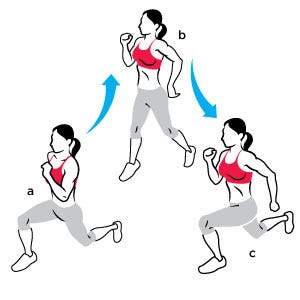
Plyometric lunges. LOVE THEM.

Take me: I’m a jumper. I love weight training, but I always have plyometrics in there somewhere. Without them, I feel like I just haven’t worked hard enough. Eleven years ago, leading up to my wedding, I realized that with everything else going on, I couldn’t do it all — work, wedding planning, teaching fitness classes and weight training — something had to give. So, I let my weight/plyo training fall off for about six weeks and, looking at my wedding photos, I still regret it. My body does what it does, and it responds better to weight training than to anything else. For me, cardio is a fairly unenjoyable bonus activity, a few extra calories burned, but the weights are what give me my shape.
When I moved here, I looked at gym memberships so I could keep on jumping. Having taught a class or three every week since I was 17, I’ve never had to pay for a gym membership; the prices were a shock, not even factoring in the London prices and the exchange rate. So, when our boxes arrived, I unrolled my yoga mat and considered myself happy enough. I’d done yoga on and off for 20 years. It feels good, is great for my hips and low back, and when I do it consistently, I feel great. But it turns out that I don’t feel great if it’s my only workout.
A few months of yoga, and I took up with a very organized and ambitious running group three times per week. I don’t like running, but I liked them. I thought that the combination of running and yoga would be a good balance, and I was right: upper body static strength, lower body endurance, and stretching out overused muscles…there’s a reason why running and yoga is a classic pairing. With my group, I ran 6–10 miles three times a week, and still yoga’d (real word) once a week. I dropped a few pounds and after a few months, I went out to buy new pants.
The reflection in the change room mirror (the rear view, to be specific) told me what I already knew: I needed my weight training, stat. Still a cheapskate, I added in calisthenics — bodyweight exercises at my local trim trail. Surrounded by super-fit current-and-former gymnasts, all men, most of them shirtless, I struggled to do some pullups. Some leg lifts. Some swinging across monkey bars and and upside-down shoulder presses. Twenty minutes later, I had finished up with jump lunges, skaters and burpees, and I was not only humbled and shaky, but done. I was unable to walk naturally, nor sit nor stand without whimpering for a few days, but gradually I was able to do more reps of more exercises, become more creative with my movements, and sit down with (relative) ease within two days of working out.
Between the running (Monday/Wednesday/Friday), yoga (Tuesday) and calisthenics (Thursday), yes, I was exercising five days per week, but with the addition of my booty-building routine (see what I did there?), suddenly, my body shape started to change, and so did my outlook. I could comfortably chat as I ran up the hills. I enjoyed yoga more, because instead of trying to squeeze as much of a workout out of it as possible, I could focus on trying to master the poses (as far as I was able to). And on Thursdays or Saturdays, I would happily tackle the trim trail with vengeance, adding in plyometrics and aiming to be a little beast in each exercise, easily getting it over with in 30 minutes or less.
This combination gave me peace of mind and mindfulness (yoga), social time and inadvertent cardio (running group), and stronger muscles, more body confidence, and a nicer “hanger” for my clothes.
Whatever your sport, you are missing out if you don’t add another (drastically different) element (or two) to your fitness routine. It’s good for your go-to workout, good for your mind, and great for my glutes.
Er… your body… I meant it’s great for your body.
(But yeah, it’s also great for my glutes.)

Originally published on Medium.com. 

Favourite posts